
Scheduling that understands how your business runs
Sorinq builds the week around your real coverage rules, tracks every punch to the minute, and turns it into numbers payroll can use — so the schedule stops living in a spreadsheet.
Most shift schedules are still built by hand, in a spreadsheet, on a Sunday night
And they break the moment someone calls off. The manager rebuilds the grid from memory, forgets that one person is at 38 hours already, and finds out on payday that the week went into overtime. Meanwhile the certifications live in a filing cabinet and nobody notices a lapsed permit until an inspection.
Sorinq puts the rules, the availability, the balances, and the punches in one place — and keeps them consistent with each other.
- Every punch
- Clocked to the minute, with unpaid breaks deducted automatically
- Zero drift
- Overtime computed from your thresholds, not a hardcoded 40
- One source
- Availability, time off, and coverage rules in the same engine
- Full history
- Audit trail on schedules, approvals, and edits
Capabilities
Everything the week actually requires
Scheduling is the visible part. The work underneath it — balances, credentials, coverage, overtime — is where the hours really go.
AI schedule generation
Describe how your business actually runs — minimum coverage per position, who can close, the two people who can't work the same shift. Sorinq drafts the week around those rules, respects approved time off and availability, and flags anyone it had to push into overtime.
PIN time clock
Turn any tablet into a punch station. Four digits, no badges, no app installs. PINs are stored as salted bcrypt hashes behind a keyed fingerprint, and repeated wrong entries throttle per PIN, per kiosk, and per IP.
Payroll-ready reporting
Every punch resolves into regular, overtime, holiday, and PTO hours using your own thresholds — weekly, daily, or both. Export the period as CSV or PDF when it's time to run payroll.
Time off that reconciles
Accruals earn per hour worked, with seniority tiers, waiting periods, rollover caps, and negative-balance rules. Approvals check the balance before they commit, so the ledger never drifts from reality.
Credential tracking
Licenses, certifications, and recurring training with per-template warning windows. Food handler cards, alcohol service permits, CPR — see what expires in the next 30 days before it lapses on shift.
Call-offs & shift swaps
Log a call-off in seconds, record who covered, and track whether it forced overtime. Employees trade shifts between themselves; managers approve or deny with the full picture in front of them.
Product tour
A closer look
Screens from a working deployment — a 46-person restaurant group running a full year of schedules, punches, and time off.
The week at a glance
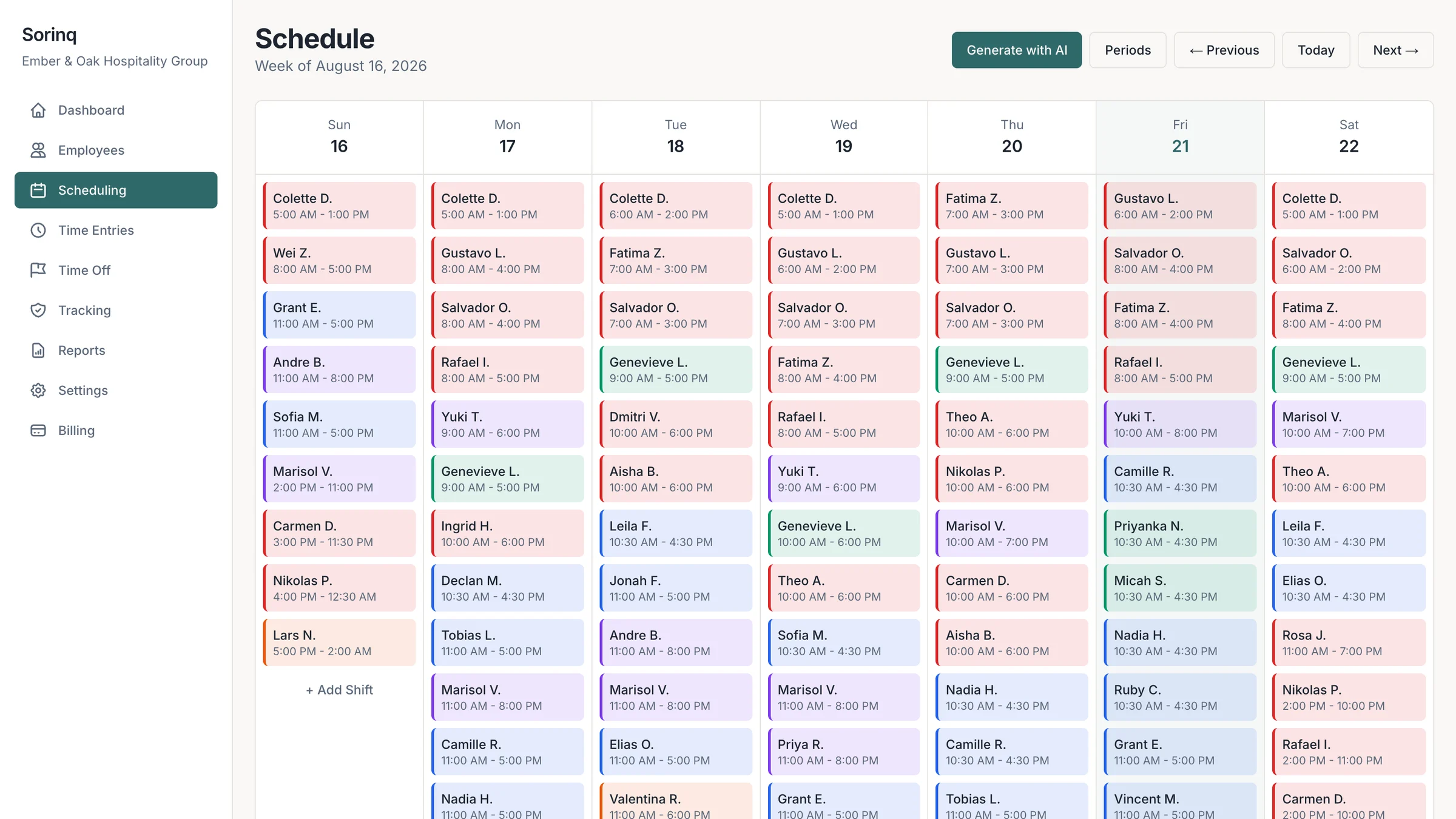
Every shift, colour-coded by department, laid out Sunday through Saturday. Drag in a shift, hand the week to the AI generator, or publish and let the team know.
Payroll without the spreadsheet
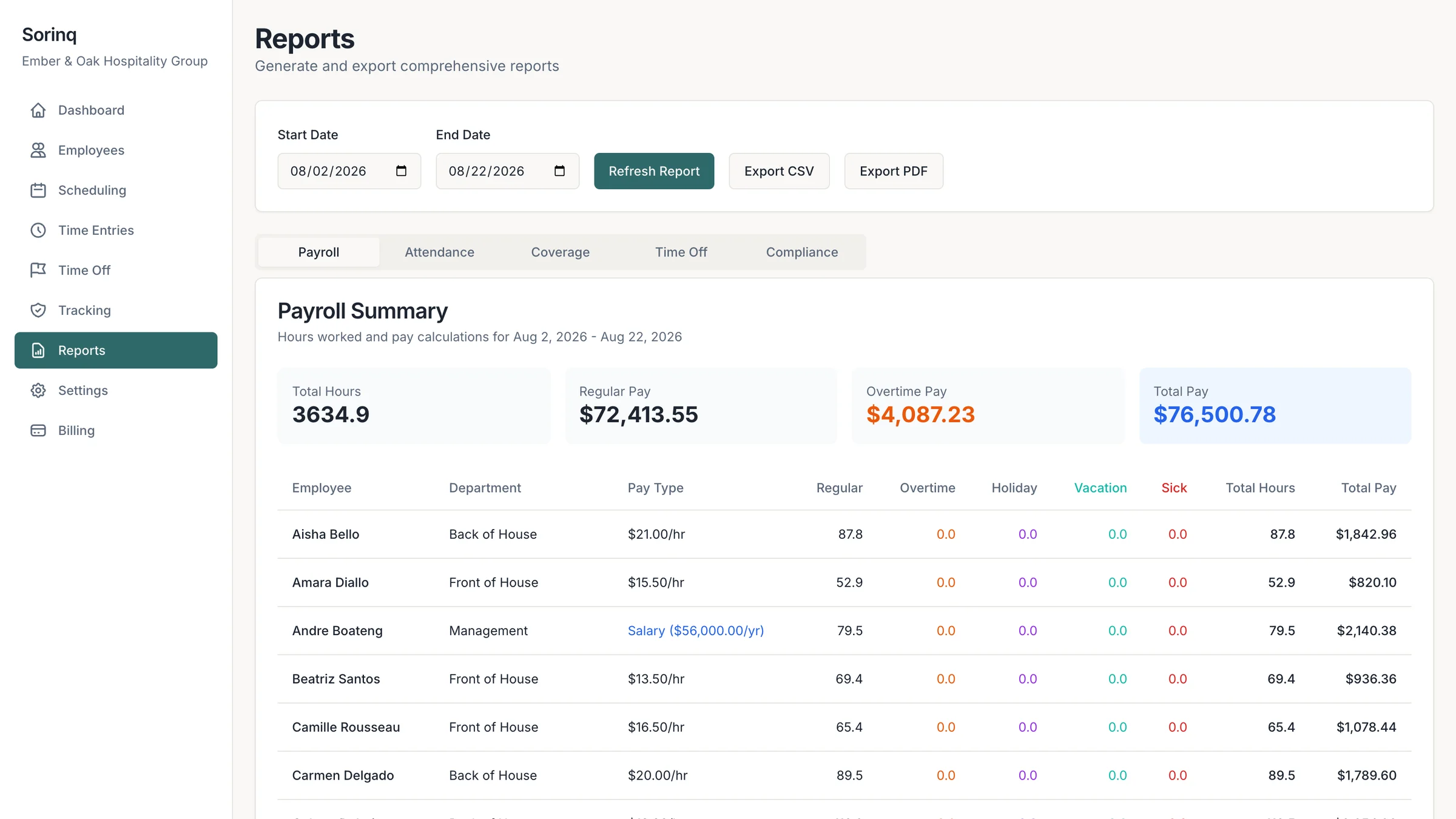
Hours resolved per person into regular, overtime, holiday, vacation, and sick — with pay computed from each employee's rate and your overtime rules. Export and run payroll.
Nothing expires unnoticed
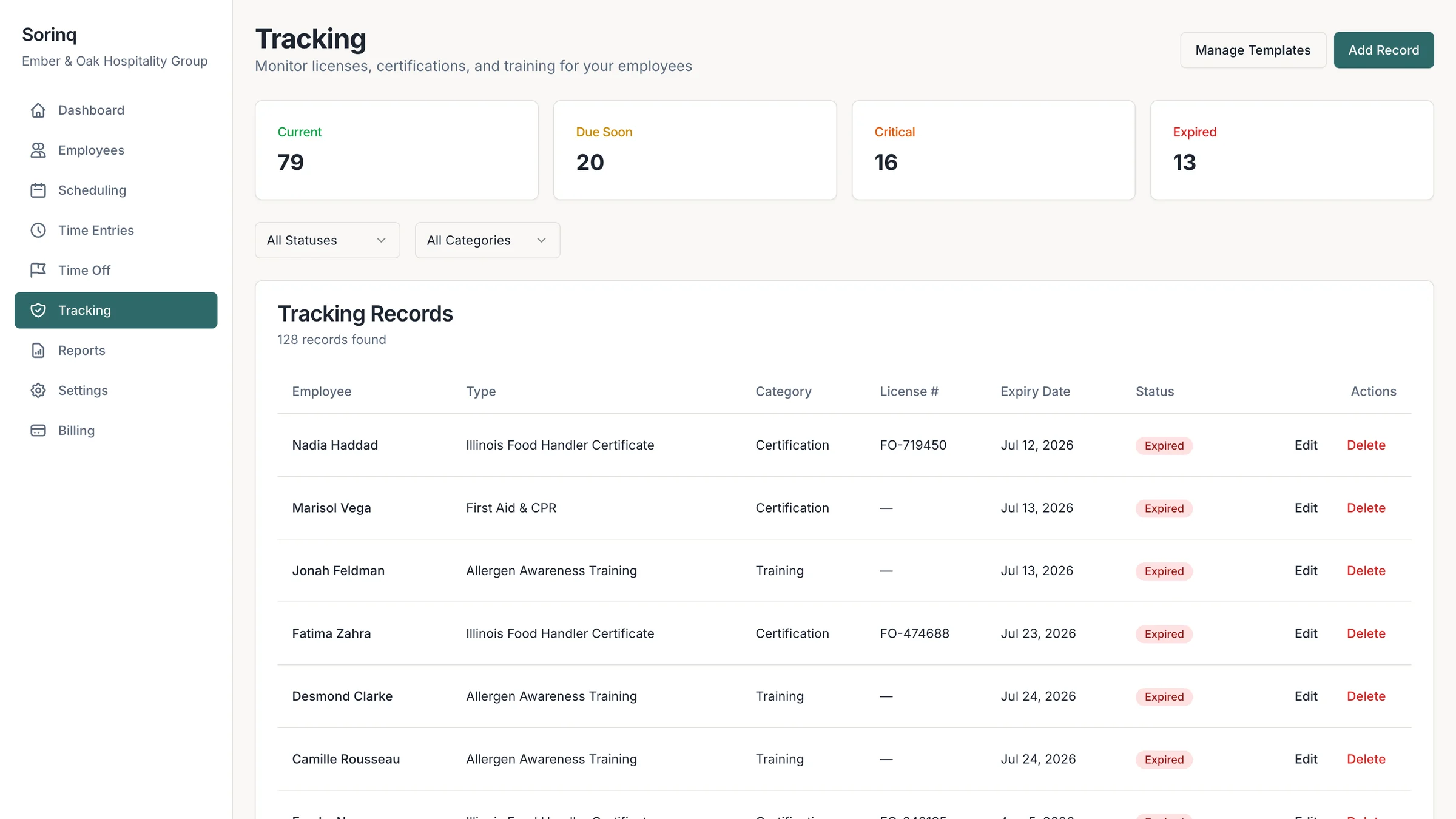
Certifications bucketed as current, due soon, critical, or expired, sorted by expiry date. Filter to one department and see exactly who needs a renewal booked.
Today, at a glance
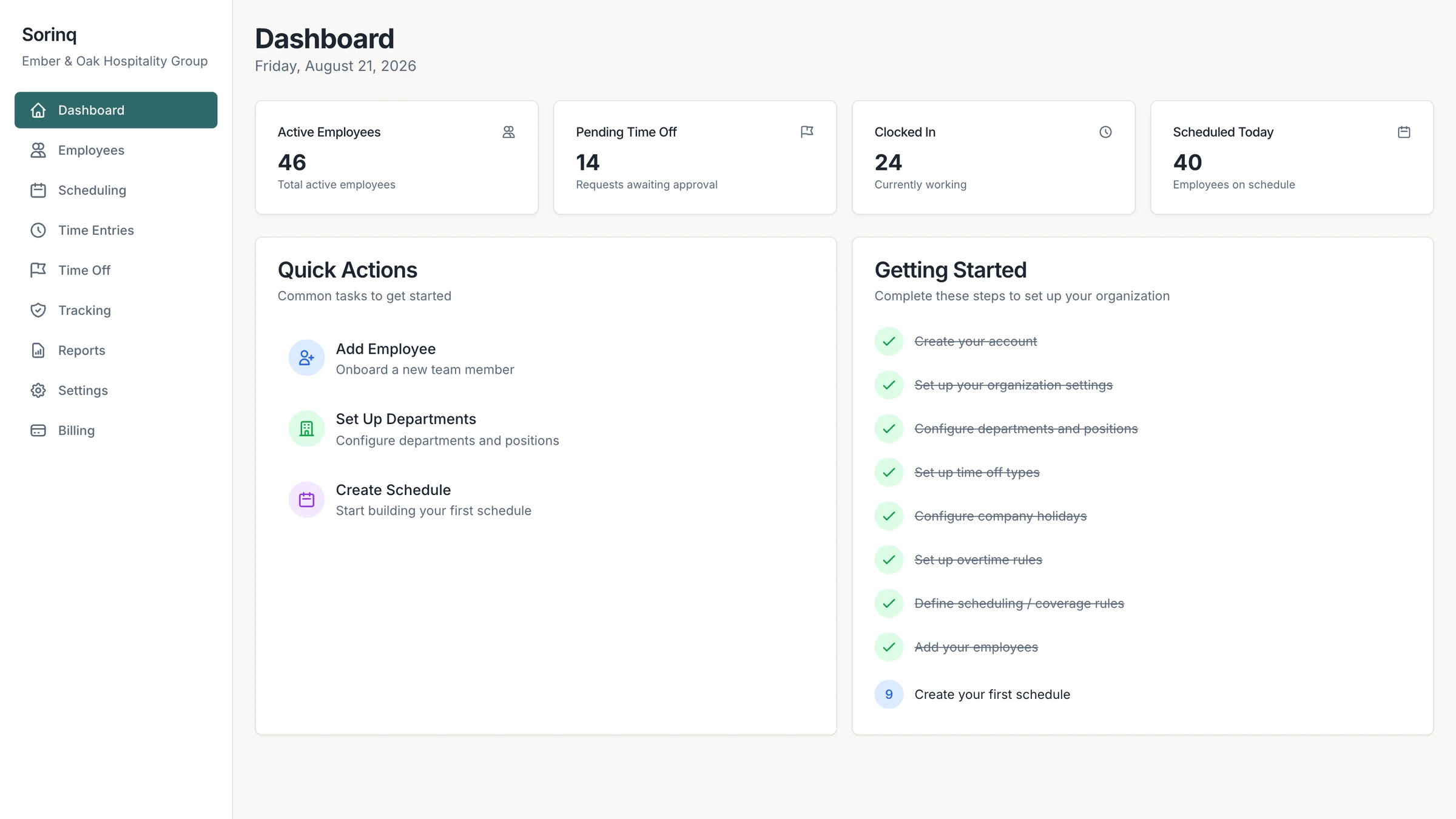
Who's on the clock right now, who's scheduled, and what's waiting on your approval — the four numbers a manager checks before walking the floor.
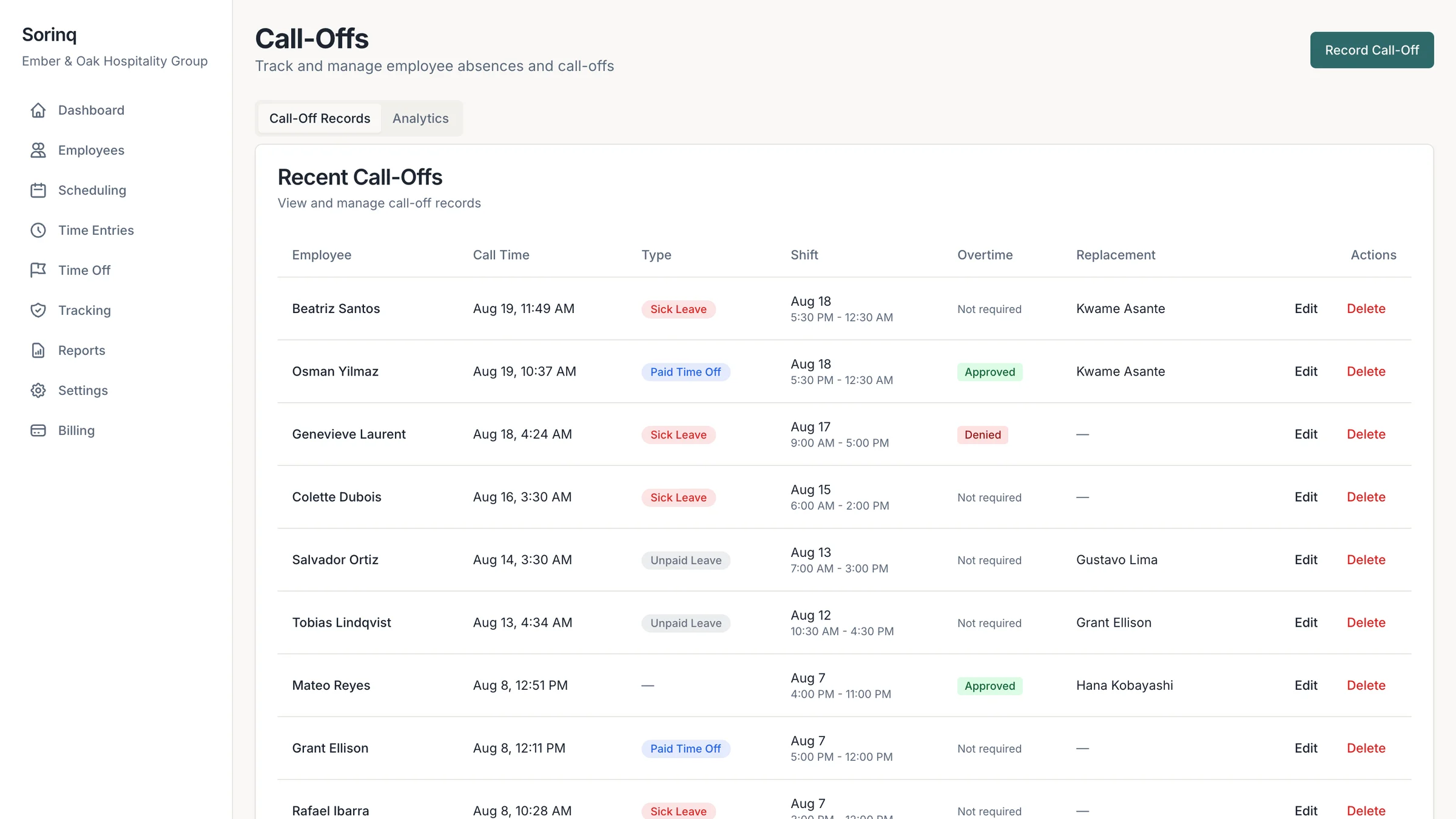
Absences with the full story
Who called, when, what shift it hit, who covered it, and whether it triggered overtime. The record you need when a pattern starts forming.
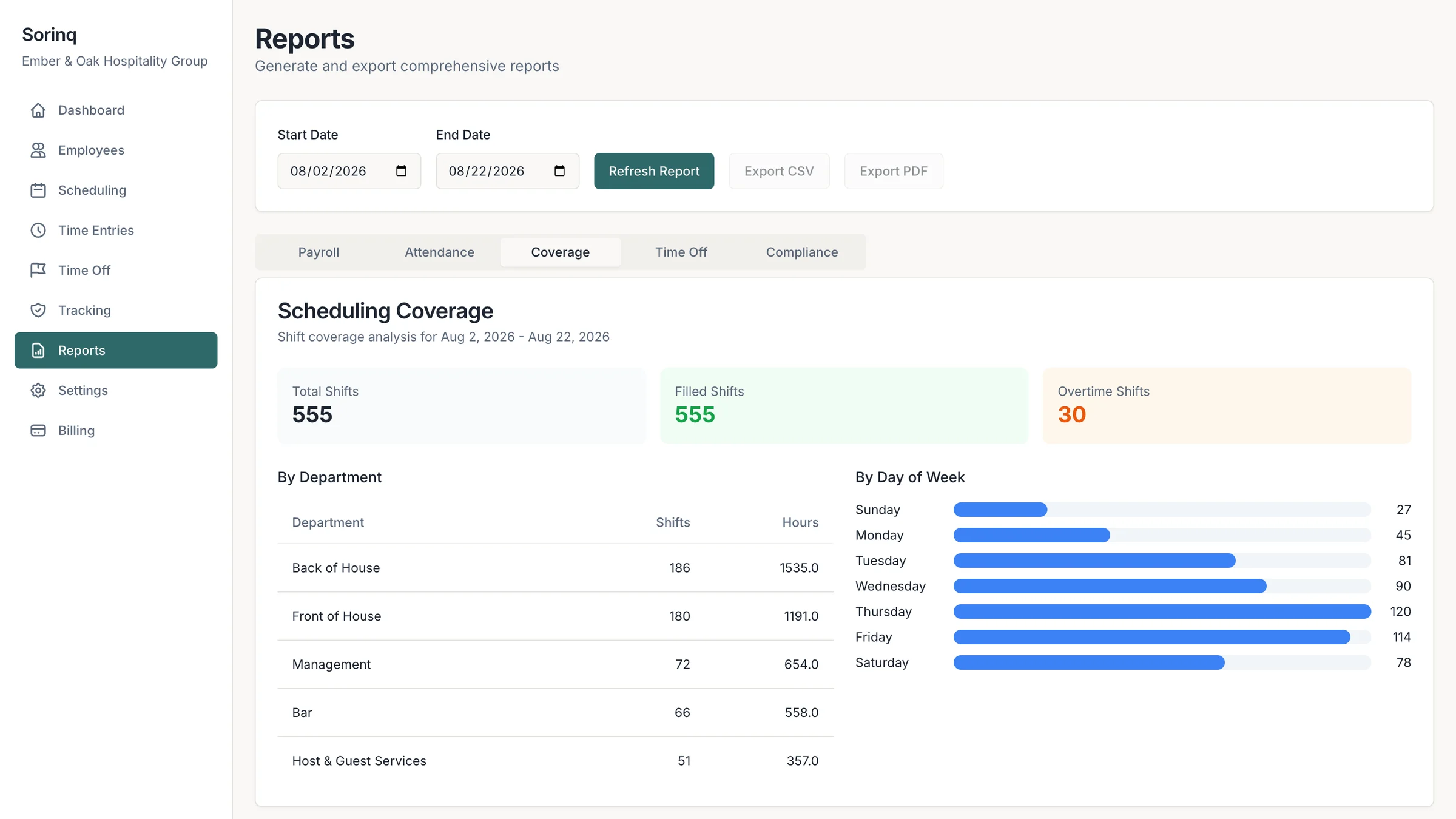
Coverage you can defend
Shifts and hours by department, plus the shape of your week by day. See where you're overstaffed on a Tuesday and thin on a Friday.
How it works
From a blank week to published in four steps
Setup happens once. After that the weekly loop is generate, adjust, publish.
- 01
Describe how you operate
Set up departments and positions, then write the coverage rules: two servers minimum on a weeknight, three on Friday, never fewer than one closing bartender. Add holidays, overtime thresholds, and your time-off policies.
- 02
Collect availability
Staff submit the days and hours they can work, and request time off from their own portal. Managers approve, and everything approved becomes a hard constraint on the schedule.
- 03
Build the schedule
Generate the week with AI or lay it out by hand. Either way the same rules apply — coverage minimums, maximum consecutive days, and the rest window between a close and the next open.
- 04
Publish and track
Publishing emails every employee their shifts. From there the kiosk records the punches, and the difference between scheduled and actual becomes your payroll and attendance reporting.
Who it's for
Built for teams where coverage is the whole job
Restaurants & hospitality
Split shifts, tipped roles, a Friday that needs double the floor staff of a Monday, and alcohol-service certifications that can't lapse.
Senior care & healthcare
Round-the-clock coverage, hard minimum staffing ratios, and licensure that has to be current on every single shift.
Retail & multi-site
Several locations, part-time staff with school schedules, and seasonal peaks that need the roster to flex fast.
Under the hood
Engineered like software that handles payroll
Multi-tenant from the first migration, with row-level security enforced in the database rather than trusted to the application layer.
- Next.js 16
- App Router, React Server Components
- TypeScript
- End to end, strict mode
- PostgreSQL
- Row-level security per tenant
- Supabase
- Auth, database, and storage
- Tailwind CSS
- With Radix UI primitives
- OpenAI
- Constraint-aware schedule generation
- Tenant isolation enforced by Postgres row-level security, so a query can't cross an organisation boundary even if the application asks it to.
- Kiosk PINs stored as salted bcrypt hashes behind a keyed HMAC fingerprint, with per-PIN, per-kiosk, and per-IP throttling.
- Time-off balances moved through a single reconciler with atomic database-side deltas, so concurrent approvals can't corrupt the ledger.
- Overtime, accrual, and scheduling-constraint logic extracted into pure functions under unit test — 155 tests covering the maths that turns into money.
Interested in Sorinq, or something like it?
Sorinq was designed and built by Roxstar Labs. If you'd like a walkthrough, or you have a product of your own that needs building, we'd like to hear about it.
Contact Roxstar Labs